

Bell’s Palsy Acupuncture
Bell’s Palsy
Overview
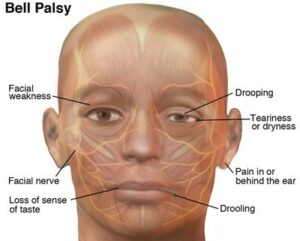
Bell palsy, more appropriately termed idiopathic facial paralysis (IFP), is the most common cause of unilateral facial paralysis.
Bell palsy is an acute, unilateral, peripheral, lower-motor-neuron facial nerve paralysis.
Symptoms:
-
Acute onset of unilateral upper and lower facial paralysis (over a 48-hr period)
-
Posterior auricular pain
-
Decreased tearing
-
Hyperacusis
- Taste disturbance
- Otalgia
-
Weakness of the facial muscles
-
Poor eyelid closure
-
Aching of the ear or mastoid
-
Tingling or numbness of the cheek/mouth
-
Epiphora
-
Ocular pain
-
Blurred vision
-
Flattening of forehead and nasolabial fold on the side affected by palsy
-
When patient raises eyebrows, palsy-affected side of forehead remains flat
-
When patient smiles, face becomes distorted and lateralises to side opposite the palsy
Researchers note that modern Traditional Chinese Medicine (TCM) sources indicate that Bell’s Palsy involves inflammation of cranial nerve VII affecting regions of the stylomastoid foramen or the facial canal and ancient references indicate Yangming and Shaoyang channel obstruction.
Guiding treatment principles are to dredge the channels, expel external pernicious influences, and to improve blood circulation.
A macroscopic TCM view indicates that localised stimulation of facial muscles promotes recovery.
Bell’s palsy according to TCM
According to Traditional Chinese Medicine, facial paralysis is known as ‘deviated mouth’. It was attributed to ‘wind’ by past dynasties.
- ‘Qi’ refers to the vital substances comprising the human body and the physiological functions of viscera and bowels, channels and collaterals.
- It maintains life activities and reflects the resistance of the human body.
- Deficiency of ‘Qi’ allows the invasion of exogenous pathogenic wind.
Acupuncture is part of Traditional Chinese Medicine and dates back thousands of years. It involves inserting fine needles into specific points on the skin or applying various other techniques to the acupuncture points to bring about healing.
Now considered a mainstream option for several medical conditions, acupuncture is proving to be effective in treating and managing Bell’s Palsy. Studies have shown that acupuncture may provide up 60-70% improvement rates – even for those experiencing chronic Bell’s Palsy.
Proof?
Acupuncture reverses facial paralysis due to Bell’s Palsy?
Researchers from the General Hospital of People’s Liberation Army (Beijing) compared two types of acupuncture for the treatment of infranuclear facial paralysis affecting the facial nerve (cranial nerve VII).
- One treatment protocol achieved a 98% total effective rate and
- the other acupuncture protocol achieved a 90.7% total effective rate.
Based on the data, acupuncture is recommended for the treatment of facial paralysis due to Bell’s Palsy.